
Choosing your mode of transport for getting around Sri Lanka can be daunting, and confusing. In this travel guide we compare four different modes of transport in Sri Lanka. From bus and train travel, to a self-drive tuktuk, and car with driver. Read on to discover the ideal Sri Lanka transport for your next trip!
TRANSPORTATION IN SRI LANKA
Sri Lanka is a small island with an extensive road network. Deciding the most convenient way to get around in Sri Lanka is an important factor to consider when you plan your trip to this enchanting country.
Ultimately, the best way to get around the country depends on your travel style, time restraints, and travel budget.
COMPARING OPTIONS FOR GETTING AROUND SRI LANKA
When you compare the four different ground transportation options, each one offers a unique way to experience Sri Lanka, and comes with its own set of pros and cons. We hired a tuktuk and drove ourselves around the island. A self-drive tuk tuk offers an authentic, and adventurous journey, and we absolutely loved this transport.
| BUS | TRAIN | TUKTUK | CAR/DRIVER | |
|---|---|---|---|---|
| COST | Cheap | Affordable | Affordable | Most expensive. |
| INDEPENDENCE | Low, as relying on schedules. | Low, as relying on schedules. | High, as have total freedom to explore without relying on anyone. | Moderate as dependent on the driver. |
| FLEXIBILITY | Low, as reliant on predetermined routes and schedules. | Low, as reliant on predetermined routes and schedules. | High, you can travel at your own pace, stop wherever and whenever you want. | Moderate , as dependent on driver willing to change the agreed route. |
| STORAGE SPACE | Limited, as dependent on available space on bus. | Limited, as dependent on available space on train. | Limited storage space in rear of tuk-tuk. Less space than in a car. | Moderate depending on size of the vehicle. |
| ACCESS TO BACKROADS | Low, as following a bus route. | Low, as following a train route. | High, as a tuktuk’s size allows easier access to narrow roads and remote areas. | Moderate, as limited by car size, road accessibility, and drivers not wanting to venture off the beaten track. |
ARRIVING AT SRI LANKA
Bandaranaike International Airport is about 32kms north of Colombo, the country’s capital. This is the airport where most international visitors fly into. There are different options available for travelling from the Airport to your first destination.
- Pre-book a private transfer and your driver will be waiting for you in the arrival’s hall.
- Direct express way public buses depart from the airport every 15 minutes, and head to Colombo (Pettah) Central Bus Stand within 30 minutes. From there you can reach any part of the country.
- Airport taxis can be booked from the counter in the arrivals hall and prices can be found on their official site.
- PickMe and Uber are the best options for shorter journeys such as to Colombo.
- Depending what time you arrive, you could start your trip with your private car and driver from the airport. If you are heading to the south or west coast, the journey to say Galle, will take about 2.5 hours via the high-speed expressway.
We headed straight to Negombo to begin our Sri Lanka Itinerary, and had a free transfer with Belmont Boutique Hotel, our accommodation for the first night.
GETTING AROUND SRI LANKA BY BUS
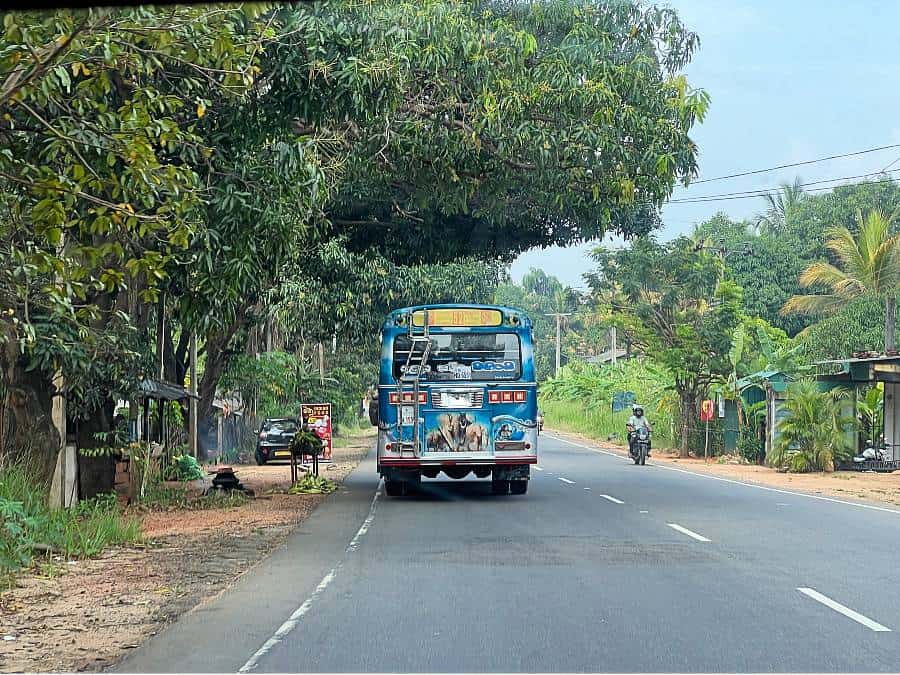
Bus travel is the staple mode of transport in Sri Lanka. Buses allow you to experience daily life alongside locals and are the cheapest method of transportation in Sri Lanka. There are two main types of buses.
Government owned buses (SLTB) are painted red, and Private buses are usually blue. Only buses operated by SLTB are available for booking. You can also only reserve long distance buses.
PROS:
- Affordability: Bus travel in Sri Lanka is the most budget-friendly way of travelling from one place to another.
- Frequency: Sri Lanka bus routes cover even the more remote areas of the island, with buses running frequently.
CONS:
- Comfort: The buses are often old, dirty, rattling, and packed with people leaving little to no room for your luggage. Your journey is a combination of slowness, interspersed with bursts of speed as the bus careers around tight corners. This is followed by a slamming on of the brakes sending you forwards in your seat, if you have one.
- The Drivers: Bus drivers think they own the roads, blaring their horns, and expecting everyone else to move aside out of their way. Their driving is nerve-racking to say the least with slamming of brakes, and barely stopping for passengers to jump off at a stop.
- Rivalry: Drivers thrash the vehicle to get to the next stop ahead of competing vehicles, with accidents caused by racing, all too common. We witnessed one bus ramming into another, due to the gung-ho driving style of a bus driver.
- Time: If you are only spending a week in Sri Lanka you don’t want to waste any precious time waiting around for buses.
After witnessing how many bus drivers drive, I suggest you take another form of transport. If you really want to take the bus, enlist the help of your accommodation hosts to help with the bus schedules.
If you are a backpacker looking for the cheapest Sri Lanka transport, the bus is it, especially if you are spending 3 weeks in Sri Lanka, and can travel around slowly.
Although most buses display their destination in both Sinhala, and English, it can still be difficult and time-consuming to find the relevant service you require.
Fares range from 1-5 USD per journey. Example fares include Tangalle to Ella ($1 USD), Colombo to Wilpattu ($4 USD). Some sample Sri Lanka bus routes are:
- Sri Lanka bus route number 101: From Moratuwa to Colombo Fort.
- Bus route number 02: From Central Bus Stop – Fort to Galle Central Bus Station.
- Bus route number 45: From: Kandy – Good Shed to Trincomalee.
GETTING AROUND BY TRAIN

Taking the train in Sri Lanka is a great way to view the island’s diverse landscapes, from sandy beaches to lush tea plantations. Originally built by the British in the 19th century, the network consists of three principal lines, and is run by Sri Lanka Railways.
Train travel around Sri Lanka is a great way to experience a real cultural experience. The most scenic routes will become highlights of your visit, in particular the scenic journey from Colombo to Kandy and up into Tea Country plus the coastal train from Colombo to Dutch colonial Galle.
PROS:
- Affordable: Train travel around Sri Lanka is an economical option, with three different classes to suit all budgets.
- Scenic Routes: Journeys offer vies of beautiful landscapes. Of particular note are the routes from Colombo to Galle, Colombo to Kandy, and Nuwara Eliya to Ella.
- Authentic: You have the chance to chat with locals.
CONS:
- Timings: Trains are slow and often delayed, so not a good option if you are short on time.
- Booking: On many services, reserved seating tends to sell out quickly, so it pays to plan ahead. SLR don’t offer online booking services, so you must go through a private operator.
TOP TIP: See what Sri Lankan trains are really like, and explore train times, and how to buy tickets at this wonderful site.
MAP SHOWING THE THREE MAIN RAILWAY LINES IN SRI LANKA
NORTHERN LINE: Runs from Colombo through Anuradhapura to Mannar and terminates in Jaffna. One branch goes East to Trincomalee, and another goes to Polonnaruwa, and Batticaloa.
SOUTHERN LINE: Runs from Colombo down the west coast past Aluthgama, Hikkaduwa, Galle, and Mirissa, to Matara. Recently renovated, this is a very scenic train ride.
EASTERN LINE: From Colombo the line runs through Kandy, Hatton (for Adam’s Peak), Nanu Oya (nearest line for Nuwara Eliya), and Ella to Badulla. One of the most scenic sections runs from Haputale to Ella.
CLASSES OF TRAIN
There are three classes on the trains, dependent on budget and comfort. Many trains, however, have no 1st class, consisting exclusively of second and third class carriages.
- Second Class Seats: Fans in the carriages, and padded seats, plus you can open the windows.
- Third Class Seats: Seats have very little padding and cannot be reserved. Sit or stand wherever you can, along with the locals. Space is minimal and the carriages get very overcrowded with basic facilities.
- First Class: Different types of seating available on selected trains; sleeper, air-conditioned, and observation cars (with large windows) Seats must always be reserved in advance.
Sri Lanka Railways 2nd & 3rd class unreserved cars cannot be booked in advance.
TICKETS FOR RESERVED SEATS
If you hold a reserved seat ticket, you are guaranteed a seat on the train. Only seated passengers are allowed in the carriage, so they are not as crowded. Your ticket will have a seat number printed on it.
- Longer-distance trains have a designated 2nd class reserved car and sometimes a 3rd class reserved car. 1st class seats are always reserved.
- Seats in these reserved cars can be booked up to 30 days in advance.
- Tickets for the reserved cars often sell out, so it’s a good idea to buy tickets in advance before you get to Sri Lanka.
- Reserved cars are guarded by an attendant.
- If you are told that the train is full, it simply means that the reserved seats on that train have sold out. You can still purchase unreserved tickets at the station on the day, for the 2nd & 3rd class unreserved cars, these cannot sell out.
- Seats in 1st class observation cars & the air-conditioned 1st class car on the blue trains from Colombo to Kandy & Badulla usually sell out almost as soon as booking opens as do 1st class sleeping berths on all the Night Mail trains. 2nd class reserved cars also sell out well in advance on the Hill Country trains from Colombo to Kandy & Badulla, so book ahead.
Tickets for reserved seat cars can be purchased from counter 17 at the Berth/Intercity Reservations Office at Colombo Fort. Access the counter from the front of the station towards the left-hand end of the station façade. Inside the office you will find different counters for specific train routes.
Opening hours are 6am-2pm and closed for lunch between 12.30pm-1pm. The counter is sometimes open until 5pm!
Tickets cannot be purchased from The Railway Tourist Information Office at the front of Colombo Fort, only expensive tours.
Reservations can also be made at ticket office counters 1 & 2, (marked as the Intercity counter) at Kandy Railway Station.
TICKETS FOR UNRESERVED SEATS
Note that 2nd & 3rd class unreserved cars cannot be booked in advance.
Don’t worry if you haven’t been able to secure 1st or 2nd class reserved seats, and there are none available. Virtually all trains have 2nd and 3rd class unreserved cars.
Tickets are sold on the day from the ticket office, sometimes even an hour before the train’s departure. Turn up at the station, buy a ticket and board the train.
The unreserved cars are often crowded, and if you can’t get a seat, you will have to stand. If you are travelling on a weekday outside of rush hour, and boarding at the starting point of the journey you most likely will get a seat.
- On the Colombo-Galle-Matara route, virtually all seats are unreserved, so pre-booking is neither necessary nor possible.
TOP TIP: To secure a seat, board the train at Colombo Maradana Station, the stop before the main Colombo Fort station. That way you can get a seat on the right-hand side and enjoy the coastal views.
HOW TO BOOK TRAIN TICKETS IN SRI LANKA
Option 1: Buy tickets online at 12go.asia.
This reliable travel agency specialises in both bus, and train ticket booking throughout Asia. Only reserved seat tickets can be ordered, unreserved tickets must be bought at the station on the day.
To make things easier the site is programmed to show the most popular journeys and stations, such as Kandy, Nanuoya and Ella.
Buy at least a month in advance of your trip as tour operators buy up tickets in bulk to sell on, especially on the Kandy to Ella route.
The site is very easy to use, and you will either be offered e-tickets with instant confirmation, or get confirmation within 24h and be able to pick up your tickets from the station.
Option 2: Use the online advance train seats reservation at Sri Lankan Railways. It allows online booking, and vouchers must be exchanged for an actual ticket at the station.
Option 3: Purchase tickets online at VisitSriLankatours. Another recommended travel agency with an easy-to-use booking site. Tickets can be collected at most major railway stations.
Option 4: Buy tickets directly from a railway station in Sri Lanka. This is probably not the best option for people on a shorter length itinerary. Try to purchase tickets up to 30 days prior to your train journey.
Different counters sell tickets for various routes.
HOW TO GET AROUND SRI LANKA WITH A SELF-DRIVE TUKTUK
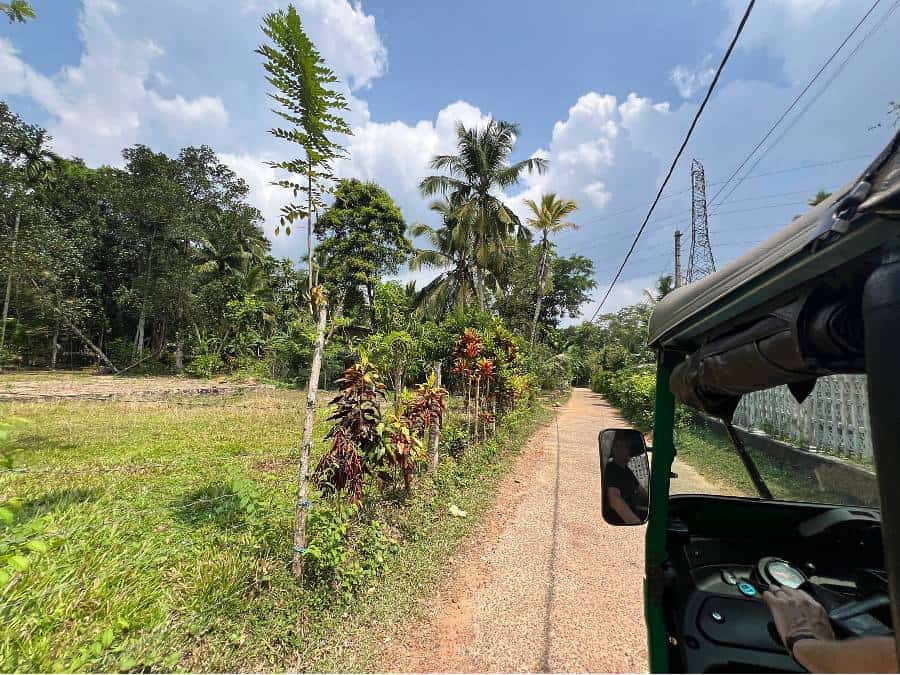
Travelling around Sri Lanka independently is the perfect way to explore the country. Navigating the island’s winding roads, and bustling towns in your very own tuktuk is the best way to travel in the country.
Tuktuks, or mororized rickshaws are an island institution, and ply the streets of every village and town. Owners often decorate their vehicles with flowers, stickers, and statues. They are a convenient way of getting around and offer a fun experience.
PROS:
- Authentic: You can immerse yourself in local culture by driving a traditional Sri Lankan vehicle.
- Total Flexibility: Follow your own Sri Lanka route travelling at your own pace and exploring off-the-beaten-path backroads, and locations.
- Local Expertise and Backup: Tuktukrental.com provide 24-hour help with all your needs, plus provide a digital map with attractions, routes, eateries, and fuel stations.
- Eco-Friendly: Carbon emissions are offset by the rental company, making your journey more sustainable.
- Affordable: The cost for 7 days in Sr Lanka is 22 USD per day.
- Adaptable: You can take a train journey, and the rental company will pick up, and drop off your tuktuk to a new destination for a small fee.
CONS:
- Noise: It is certainly a noisy ride, but the locals wave at you as you pass, and chat to you when you stop.
We hired and drove our own tuktuk around the island, and we absolutely LOVED our experience. When you visit Sri Lanka, getting around is an important part of your holiday. We drove up the West Coast, visited National Parks, and explored towns including Kandy, Ella, Dambulla, Sigiriya Rock, Nuwara Eliya, and more.
We would thoroughly recommend hiring your own three-wheeler to stop at any point of interest and take in the scenery at your own pace. If you are interested, check out the official site of Tuktuk Rental for more information.
Even if you don’t decide to hire your own tuktuk, make sure to take at least one or two short journeys in one during your trip. Make sure to agree a price with the driver before you set off, but a general rule is roughly 40-50 Rupees per kilometre.
Most tuktuk drivers are honest, and will offer you a fair price, so be sure to give them a small tip to show your appreciation for the journey.
HIRING A CAR AND PRIVATE DRIVER
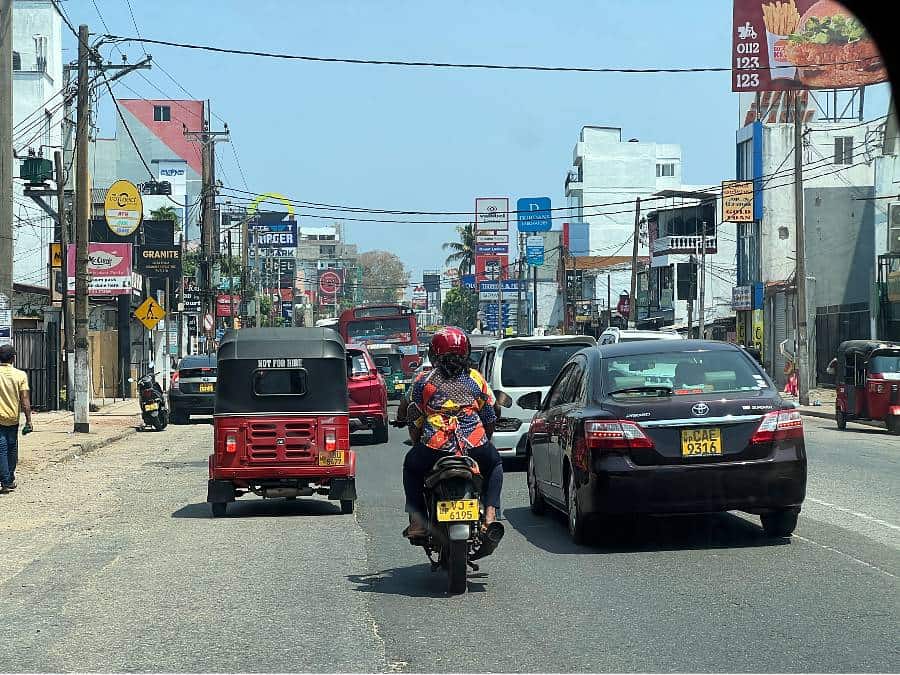
Hiring a car with a private driver is a popular choice for first time visitors looking for comfort, and convenience. You can sit back in an air-conditioned vehicle and be driven from place to place by a driver who can also act as a guide.
Some drivers charge to simply drive you from one destination to another, while others hold a tourist board license and can also act as a guide. You can use the services of a car and driver for the whole length of your trip, or just part of it.
PROS:
- Comfort: You can enjoy a spacious and air-conditioned vehicle.
- Convenience: Offers flexibility for travelling longer distances.
- Local Expertise: A local driver can recommend attractions to visit, and has local knowledge regarding history, customs, and places to eat.
- Luggage Storage: You can safely leave your luggage in the boot, and not have the hassle of carrying it around with you.
CONS:
- Cost: This is the most expensive way to travel around the country, compared to bus, train, and tuktuk.
- You could have your driver with you for a good part of each day.
BOOKING A CAR AND DRIVER FOR SINGLE TRIPS
If you want total flexibility throughout your trip, you can book a driver a day at a time. This is an ideal choice if you want to have “rest days” and relax at your accommodation pool.
- Ask your accommodation the day before travelling to recommend and book a driver for you.
- You can negotiate the price as you are not paying a fixed rate for a day or week, and don’t have to cover your driver’s accommodation.
- You are free to also use a bus or train or take a tuktuk ride.
- It may suit you to have a new driver each day if you simply want to use the service as a comfortable ride to your next destination.
HIRING A CAR AND DRIVER FOR YOUR ENTIRE SRI LANKA TRIP
If you prefer to spend your whole trip relaxing in the back seat looking out of the window while your driver navigates the chaotic roads, then hiring a car and driver for your entire trip may suit you.
You may wish to follow a set itinerary with no deviations.
Bear in mind that the cost will be higher, as you will be expected to cover fuel and accommodation for your driver. Most hotels have “driver’s rooms” at a minimal cost.
- The more time spent with your driver, the more you will get to know each other, and they will understand your needs and preferences.
- The price will be set from the offset for your whole trip, so you know what the cost will be.
COSTS FOR HIRING A CAR AND DRIVER
Prices depend on the size of vehicle, number of passengers, and the daily mileage. While the simplest way is to agree on a flat fee with no extras, a good average is:
- US$70-US$90 per day for 2 passengers in a small car or 4 passengers in a larger car, with a daily mileage of 150km.
- Always establish a daily mileage allowance, and total cost from the outset to avoid misunderstandings.
- Check whether the total daily cost includes fuel, and your driver’s meals/accommodation.
- If you want to spend an odd day chilling, check if there will be a cost incurred.
- Most drivers will expect a 10% tip.
- If your driver doesn’t speak your language, you will also need a guide.
- Travel agencies will probably charge more to arrange your car and driver.
What is your preferred method of transport when exploring a country? We hope this guide has made your decision for how to get around Sri Lanka easier. If you have any questions, please leave a comment below.
Found this guide useful? Don’t forget to bookmark it and share with your friends. Hover over the picture below and press the red PIN IT button that pops up.
