Dear Reader, GlobalGadding has no sponsored content, just genuine advice. Some links may be affiliate links at no extra cost to you. See our Disclosure Policy for more information.
Madeira’s natural pools are one of the island’s most iconic experiences — but they’re not all the same, and they don’t all suit every traveller or every day.
These Madeira natural pools are often shown in dramatic photos — but the experience depends entirely on the day you visit.
Scattered mainly along the north coast, these volcanic swimming pools range from fully managed complexes with lifeguards and facilities, to quieter, wilder pools shaped directly by the Atlantic.
Madeira may be small, but conditions change quickly here. Sea swell, wind, and time of day can completely alter what a visit feels like — which is why choosing the right natural pool matters more than trying to see them all.
We visited several of Madeira’s natural pools over multiple days, in different conditions, and found that the experience depends far more on timing and expectations than on distance.
This post breaks down which Madeira natural pools are actually worth visiting, what each one feels like, and when to go — so you can enjoy them safely, calmly, and without feeling rushed.
🔍 Quick Answer: Are Madeira’s Natural Pools Worth Visiting?
Yes — absolutely, as long as you choose the right pool for the day and conditions.
Here’s the short, honest breakdown:
- Porto Moniz Natural Swimming Pools → Iconic and safest option, but the busiest
- Seixal Natural Pools → More scenic and quieter, but weather-dependent
- Smaller volcanic pools → Peaceful and uncrowded, best in calm seas
- Managed complexes → Easier access and lifeguards, less “wild”
- Best time to visit → Early morning or late afternoon to avoid crowds
If you’re visiting Madeira for the first time, focusing on one or two well-chosen natural pools will give you a far better experience than trying to see them all.
🌊 What Are Madeira’s Natural Pools (and Why They’re Different)

Madeira’s natural pools are formed by volcanic rock along the island’s coastline — something we noticed immediately once we started exploring the north coast.
Over time, lava flows created natural basins in the rock, which now fill with seawater as waves spill over the edges. The pools are constantly refreshed by the Atlantic Ocean, which is part of what makes them feel so alive — and why conditions matter.
Not all natural pools in Madeira feel the same. Some are fully enclosed and carefully managed, with steps, changing rooms, and lifeguards. Others are more exposed to the sea and feel far wilder.
We found that this difference changes the experience far more than distance ever does. Two natural pools may look similar online, yet feel completely different once you’re standing there.
Conditions can also vary from day to day, which is why choosing the right pool for the conditions matters more than ticking off a specific name. On calm days, even exposed pools can feel inviting.
On rougher days, the same spot might be better enjoyed from the rocks above.
This variety is what makes Madeira’s natural pools special — but it’s also why a little context goes a long way.
⚠️ Are Madeira’s Natural Pools Safe?
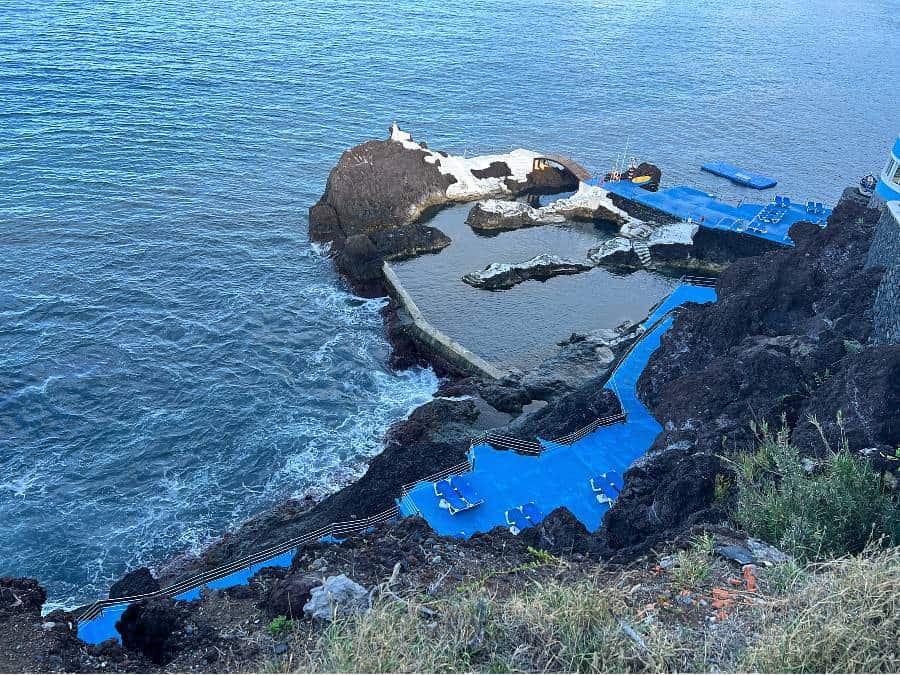
Yes, Madeira’s natural pools can be safe when conditions are right — but we quickly learned that timing and sea state make all the difference.
Some pools, particularly the larger complexes, are protected by lifeguards and flag systems. We paid close attention to these, especially on days when the Atlantic looked deceptively calm.
Even when the sun is out, Atlantic swell conditions can change quickly.
Rough seas can make swimming unsafe, even when the pool itself looks calm at first glance.
We found it was worth stopping for a few minutes to watch how the water moved — whether waves were breaking safely outside the pool or surging over the rocks and into it — before deciding whether to get in.
In winter, or during periods of strong swell, some pools may be closed entirely — especially the more exposed ones.
It’s best to avoid the pools during storms or heavy Atlantic conditions, and we found that skipping a swim on those days never felt like missing out.
One thing that surprised us was how enjoyable these places still are without swimming. Watching waves crash over volcanic rock, feeling the spray, and taking in the scale of the coastline often felt just as memorable.
Always check conditions before swimming — and remember that enjoying Madeira’s natural pools doesn’t always mean getting in the water.
🔍 Which Madeira Natural Pools Should You Choose?
Madeira’s natural pools aren’t “one size fits all.”
The best choice depends on conditions, crowds, and how much structure you want.
Here’s how the main pools compare at a glance:
| Natural Pool | Best For | Crowd Level | Facilities | Sea Exposure |
|---|---|---|---|---|
| Port Moniz (Main) | First-Time visitors | High | Full (lifeguards, lockers, café) | Low |
| Piscinas Naturais Velhas | Fewer crowds, quieter swims | Low-Medium | Basic | Medium |
| Seixal Natural Pools | Scenery & photos | Low-Medium | None | High |
| Porto da Cruz Complex | Calm, local feel | Low | Basic | Medium |
| Doca do Cavacas | Easy Funchal access | Medium | Good | Medium |
| Barreirinha | Quick local dip | Medium | Minimal | Medium |
If you already know which pool suits your style, you can jump straight to it below. Otherwise, start with the comparison above — it’ll save you time.
🗺️ Madeira’s Natural Pools Map
This map shows where Madeira’s natural pools are located — and why choosing the right one matters more than ticking off as many as possible.
You’ll notice most pools cluster on the north and west coasts, where conditions play a bigger role.
🏊♀️ The Best Natural Pools in Madeira (Compared)
Not all of Madeira’s natural pools feel the same — and that’s what makes them special.
Some are fully managed complexes with lifeguards, cafés, and changing rooms. Others feel wilder and more exposed, where conditions matter far more than facilities. A few sit right in the capital, while others require a deliberate drive along the north coast.
Based on our time visiting these pools ourselves, here’s how Madeira’s best natural swimming spots actually compare — so you can choose the right one for your day, not just the most famous name.
🌊 1. Porto Moniz Natural Swimming Pools (Main Complex)

Best for: First-time visitors | Iconic experience | Facilities
These are arguably Madeira’s most famous natural pools — and for good reason. Set directly into the volcanic coastline, the Porto Moniz natural swimming pools are large, dramatic, and constantly refreshed by the Atlantic.
The pools here are fully managed, with lifeguards, clear entry points, ladders, and changing facilities. Even when the ocean beyond looks rough, the pools themselves often feel calm and controlled.
They do get busy, especially late morning through mid-afternoon, so arriving early or later in the day makes a noticeable difference.
Good to know: This is a paid complex, and it feels more structured than the older pools — safer and easier, but less wild. Opening hours and seasonal closures are listed on the official Madeira tourism website.
🌊 2. Piscinas Naturais Velhas (Old Porto Moniz Pools / Cachalote)

Best for: Fewer crowds | A more natural atmosphere | Classic volcanic setting
Right beside the main complex, the Old Porto Moniz Pools feel noticeably different.
The rock formations are darker and more rugged, and there’s less concrete overall. While still maintained, the experience feels closer to swimming within the landscape rather than inside a managed complex.
We preferred these when the main pools felt busy. There’s more breathing space and a quieter rhythm, especially on calm days when the water settles and visibility improves.
Because they’re more exposed, conditions matter more here.
Good to know: Fewer amenities | More weather-dependent | Quieter than the main complex
🌊 3. Seixal Natural Pools

Best for: Scenery | Photography | Calm, unstructured swimming
Seixal’s natural pools are among the most scenic on the island.
Framed by lush green cliffs and dark volcanic rock, they feel wilder and less managed than Porto Moniz. On calm days, the water can be beautifully clear and inviting. On rougher days, the Atlantic makes its presence known.
We found Seixal just as rewarding to watch as to swim — especially when waves rolled in beyond the natural rock barriers.
This is a place where conditions define the experience.
Good to know: Free access | Limited facilities | Best in calm seas | Skip in heavy swell
🌊 4. Doca do Cavacas (Poças do Gomes)
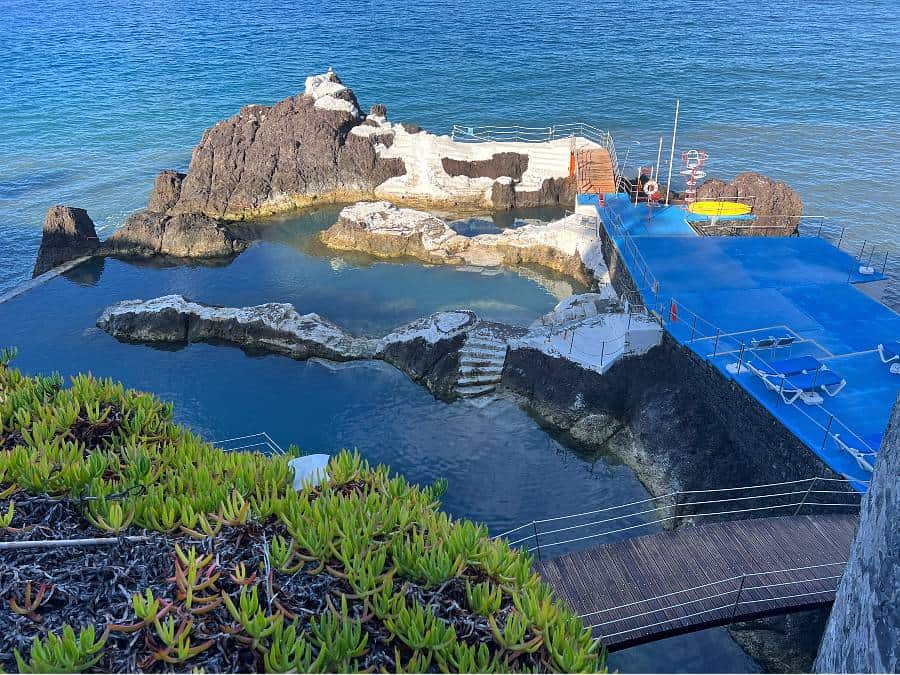
Best for: Easy access from Funchal | Short swims | Convenient stop
Located near Praia Formosa, Doca do Cavacas is one of the most accessible natural swimming spots close to Funchal.
The pools are compact but dramatic, with metal ladders, walkways, and waves crashing just beyond the rock edge. It’s an easy addition to a coastal stroll rather than a full-day destination.
We liked how simple it was to visit without needing to drive north.
Because of its size, it can feel busy during peak hours.
Good to know: Small entry fee | Urban setting | Can feel crowded | Watch for surge on rough days
🌊 5. Complexo Balnear do Porto da Cruz

Best for: Quiet swims | North coast stays | A local feel
Set beneath Penha d’Aguia on the northeast coast, this swimming complex feels calmer and far less visited than Porto Moniz.
It’s modest in size, with simple access points and a laid-back atmosphere. We found it suited slower travel days — especially when staying nearby.
There’s less spectacle here, but more space and quiet.
Conditions still matter, but it generally feels less exposed than Seixal.
Good to know: Basic facilities | Very quiet | Ideal if staying in Porto da Cruz
🌊 6. Barreirinha (Funchal)

Best for: Quick swims | Local atmosphere | Staying in the Old Town
Barreirinha sits near Funchal’s Old Town and feels refreshingly everyday.
It’s compact, straightforward, and popular with locals — especially in the morning. There’s no dramatic volcanic theatre here, just a clean swimming area with easy sea access.
We liked it as a practical option rather than a destination in itself.
It works best for early swims before it gets busier.
Good to know: Small area | Central location | Best early in the day
➕ Other Madeira Swimming Complexes to Know About
Not all ocean swimming spots on the island are natural volcanic pools — but some are still worth considering.
Lido & Ponta Gorda (Funchal)
These are structured bathing complexes with direct sea access, sun decks, and controlled swimming areas. They’re less dramatic than the north coast pools, but far more predictable — especially in rough conditions.
If you want guaranteed access to the sea without worrying about swell, these are practical alternatives.
We saw them as backup options rather than headline experiences — useful, but not the reason you travel to Madeira.
📍 Practical Tips for Visiting Madeira’s Natural Pools
Choosing the right Madeira natural pools for the conditions will make far more difference than trying to visit several in one trip.
Before you head out, a few things made a noticeable difference for us:
Best time to visit:
Early morning or late afternoon feels calmer and far less crowded — especially in Porto Moniz.
Water temperature:
The Atlantic is refreshing year-round. In summer it feels comfortable after a few minutes; in winter it’s brisk but still swimmable on calm days.
Entry fees:
Main Porto Moniz and some Funchal complexes charge a small fee. Wild pools like Seixal are free.
Getting there:
Because many of the north coast pools require winding mountain drives, it helps to understand what driving in Madeira is really like before planning a tight schedule.
We rented a car through DiscoverCars at Funchal Airport, which made reaching the north coast pools much easier.
Parking:
North coast pools can have limited parking in peak season. Arrive early if visiting Porto Moniz.
What to bring:
Water shoes are genuinely helpful on volcanic rock. We were glad we had them.
When to skip it:
If waves are surging over the pool walls or red flags are flying, enjoy the view instead. These places are just as dramatic from above.
❓ FAQs About Madeira Natural Pools
Are Madeira natural pools free?
Some are free (like Seixal), while others such as Porto Moniz charge a small entry fee.
When is the best time to visit Madeira natural pools?
Early morning or late afternoon, especially in summer, when crowds are lower and parking is easier.
Are Madeira natural pools open year-round?
Most are open year-round, but some may close temporarily during strong Atlantic swell or winter storms.
Is Porto Moniz better than Seixal?
Porto Moniz is safer and more structured; Seixal is more scenic and weather dependent.
🌿 Still Planning Your Madeira Trip?
If the natural pools are high on your list, it helps to think about where you’ll base yourself — especially on the north coast, where conditions change quickly.
We found that choosing the right town made more difference than trying to see every pool.
If you’re still deciding where to stay, this breakdown of the best towns in Madeira will help you match your base to your pace.
Or, if you’re mapping out your days, here’s our calm take on how many days in Madeira actually feels right.
Explore More Madeira Adventures
Check out these guides next:
- Driving in Madeira – a guide for first timers
- Renting a car in Madeira
- Best Towns in Madeira
- Madeira Hidden Gems
- Ponta Do Sol Madeira
- Visit Ponta do Garajau Madeira
- Cable Cars in Madeira for a thrilling ride

Meet Angela
Angela is the founder and writer of GlobalGadding, a travel resource for road-trip lovers and independent travellers.
She’s explored 40+ countries, and road tripped across New Zealand, Alaska, Australia, Canada, UK, Sri Lanka, USA, Namibia, and Europe.
She creates detailed, easy-to-follow itineraries that take the stress out of planning. Her mission is to help readers craft their own self-drive trips.