
Looking for Sri Lanka travel tips to plan your first trip to this endearing island off the southern tip of India? In this Sri Lankan guide, you’ll find all the travel tips a visitor needs to know about before visiting Sri Lanka, including when to go, visa requirements, and understanding cultural etiquette.
Sri Lanka is an underrated holiday destination. But with its recent troubled history a thing of the past, this is a country on the brink of a tourism boom. The island maybe small but its diversity embodies ancient cities, national parks, famous tea plantations, colonial architecture and much more.
For us, what really stood out was the warmth, and sense of welcome from its people. The last few decades have been incredibly difficult for the country. From withstanding decades of civil war, natural disaster, covid, and an economic crisis, Sri Lankans are positive for a brighter future.
We were humbled by their stoicism, and ability to overcome their history, and the challenges they brought. Sri Lanka is laid-back, inviting, and irresistible, and you will leave wanting to see more.
GENERAL FACTS ABOUT SRI LANKA
Currency: Sri Lankan Rupee (Rs)
Languages: Sinhala, Tamil & English
Capital City: Colombo
Time Zone: GMT+5.5 hours
Electricity: 230V, 50 cycles
Exports: Rubber, Cinnamon & Tea
25 TOP SRI LANKA TRAVEL TIPS YOU NEED TO KNOW
To help you out with your visit in Sri Lanka, here are some useful things to know about the country before you go.
1. PLAN YOUR TRIP AROUND THE MONSOON SEASONS
While it’s possible to visit anytime of the year, be aware that Sri Lanka has two monsoon periods which affect opposite sides of the island at alternate times of the year.
The Yala Monsoon season (May-August) brings lashing rain to the south and west coasts, plus the Hill Country. This effects Colombo, Negombo, Kalpitiya, Kandy, Nuwara Eliya, Ella, Haputale, Adam’s Peak.
However, the weather in the North and East is ideal. This is known as the Low Season, and prices around the island are at their lowest.
The Maha Monsoon Season (October-January) brings rain to the East Coast and Northern Regions. This affects Jaffna, Trincomalee, and Arugam Bay. Many restaurants, and beach resorts shut down during this period.
During these months, the weather in the Hill Country, and on the West and South Coasts is dry and ideal. Hence, accommodation is in high demand during this High Season.
2. ORGANISE AND BOOK TRAINS IN ADVANCE

Train travel is a great way of getting around the country, mixing with locals, and seeing the diversity of the island. For many visitors, a train ride through the Hill Country and past tea plantations is an essential part of their Sri Lanka itinerary.
A popular line runs from the capital city of Colombo, through the mountains. The scenic section between Kandy and Ella is extremely popular, and tickets sell out fast. To ensure you snag a reserved seat in first-class (air-conditioned), or second class (has fans), book at least 30-days in advance through an onsite booking agency such as 12GoAsia.
3. BE RESPECTFUL WHEN VISITING RELIGIOUS SITES
Sri Lankans have an unswervingly faith, with Buddhism and Hindu being the most prominent belief systems. Traditions are important to them. Families bring flowers to stupas
Sri Lankans Sri Lankans are majority Buddhist or Hindu, and their culture is built upon modesty, politeness, and conservative behaviour and dress, which means excessive drinking, PDAs, loud or brash behaviour, and skimpy clothing really is frowned upon.
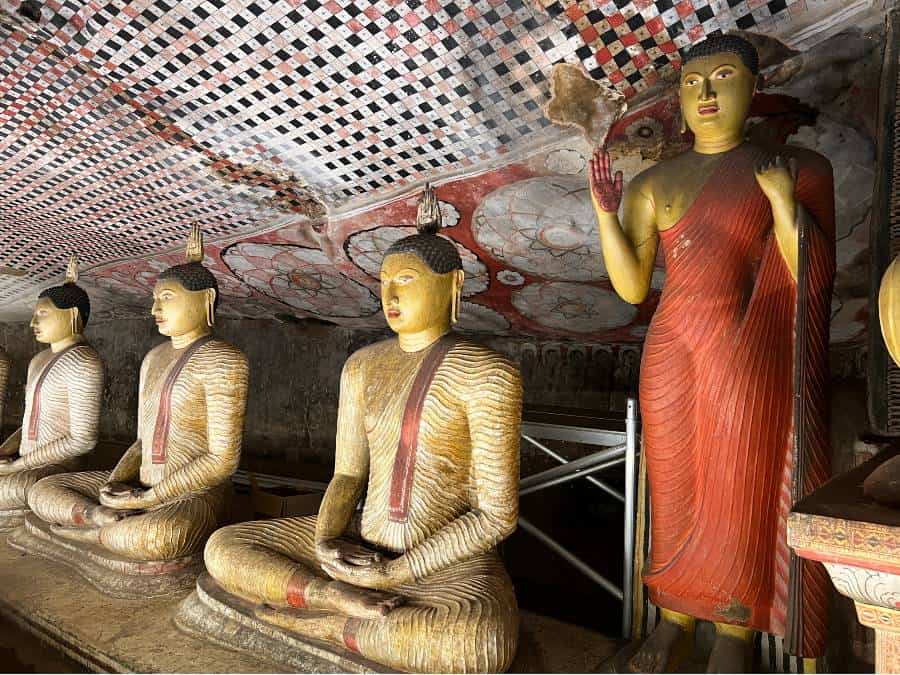
- Temples: Remove hats and footwear, and cover shoulders, arms, legs and knees. It is permitted to wear socks when walking across rocks and hot pavements.
- Buddhas: It is disrespectful to take a photo with your back to a Buddha Statue, which is a deeply revered religious figure. It is also forbidden to wear clothing displaying Buddha images.
- Photos: Always ask permission before taking someone’s photograph.
4. MAKE A NOTE OF BANK HOLIDAYS AND POYA (FULL MOON) DAYS
Every poya day is a holiday, and an important event in Sri Lankan Buddhism. Falling on each full moon arrival, these holy days are strictly observed by devout locals, and monks.
- Families come together to visit temples and make offerings.
- No alcohol is on sale in restaurants, bars or shops.
- Roughly once a month, poya days are public holidays, and each one is associated with a particular ritual. Important ones include Durutha (January), Vesak (May), Poson (June), Esala (July/August), and Unduvap (December)
We visited Anuradhapura on a bank holiday, and it was incredibly busy. What was lovely to see though, was families dressed in white, and laying flowers at temples. Later in the day we saw many such families eating together at the sides of the road, and swimming in the water tanks enjoying themselves.
5. BE ROAD SAFE HOWEVER YOU’RE GETTING AROUND SRI LANKA

While traffic in Sri Lanka is not on the same scale as neighbouring India, it can seem slightly manic. However you plan to travel in Sri Lanka, traffic is something you will notice.
We drove ourselves around in a rented tuktuk which was amazing, great fun, and the perfect way to explore independently. While not being permitted to drive on the motorways, we didn’t find driving in the traffic a problem.
With a maximum speed of 40mph, tuktuks are a great way of taking it slow, and enjoying the journey as you go.
- Buses are top dog when it comes to the roads. The honk their horns before passing, and drive at scarily high speeds.
- There is a certain “flow” when it comes to traffic. Bikes, cars, tuktuks, and buses simply move around each other.
- The common cause of traffic accidents is speed, overtaking, and suddenly pulling in with no prior notice.
- Nobody seems to stop at pedestrian crossings. But then again, pedestrians seem unfazed and cross the road unperturbed.
6. ALWAYS CARRY CASH WITH YOU
Rupees can only be purchased once you arrive in the country. While most larger hotels accept credit cards, some of the smaller guesthouses accept cash only. You will also need small bills to pay for tuktuk rides, buying drinks from roadside stalls, small grocery purchases, and tipping.
- You will find Banks and ATM machines in all main tourist areas. We used Bank of Ceylon ATMs which don’t charge a fee,
- Only withdraw what you need every few days, as you cannot exchange rupees outside of Sri Lanka.
- Try to keep a stash of smaller denomination notes.
- There are two ATMs in the arrival’s hall of the airport where you can make your first withdrawal. Don’t try and withdraw more than about 100,000 Rupees, as the machines wouldn’t work otherwise.
- We used a WISE card to withdraw cash every 4/5 days, and this worked fine.
7. ORGANISE YOUR VISA PRIOR TO ARRIVAL

Most travellers visiting Sri Lanka will require some form of visa before they can enter the country. Tourist visas are typically issued for a 30-day period. These can be applied for online via the Electronic Travel Authorization (ETA) system.
Visa Exemptions apply for citizens of Singapore, Maldives, Seychelles and The Czech Republic.
8. CHECK VACCINATION REQUIREMENTS IN ADVANCE
There are no required vaccinations for entry into Sri Lanka. However, it may be wise to check with your GP/health practitioner, with regards to recommended vaccinations. These include tetanus, diphtheria, hepatitis A, hepatitis B, and polio.
While the country is malaria-free, there are over 3 million street dogs, so if you are concerned, you might consider getting vaccinated against rabies, although cases are rare.
9. DRESS AND BEHAVE CONSERVATIVELY
Sr Lankans are deeply religious, modest, and conservative in their behaviour.
- When you are planning on visiting a Buddhist temple, or temple ruins, wear clothes that cover your shoulders, upper arms, and legs. Always be prepared to cover up, as some sites are more insistent than others. Top Tip: Bring a scarf or wrap to drape over your shoulders.
- Avoid public displays of affection, loud shouting, and inappropriate behaviour.
- Beach attire should be worn at the beach, and not for walking around town.
- Some temples ban the use of flash photography or banned entirely at some sites.
- Traditionally, Sri Lankans eat with their right hand.
10. BUY A SIM CARD ON ARRIVAL
Mobile coverage across the island is excellent with 4G readily available. Buy your sim card from one of the booths in the arrival’s hall of Bandaranaike International Airport. Main mobile companies include Mobitel, and Dialog.
You can get a FREE Dialog Prepaid SIM from the Dialog counter at the airport. Sim cards are an absolute bargain and can be picked up for as little as US$7 or US$8. Top-ups if needed can be picked up at one of the many kiosks around the island.
You will need a copy of your passport and it will take very little time to get your SIM activated.
11. DO NOT DRINK THE TAP WATER
Buy bottled water from supermarkets, and make sure the seal is intact and carries the Sri Lanka standards certification mark. Most hotels and guesthouses provide free water for guests.
12. BEWARE OF COMMON SCAMS
Throughout your Sri Lanka travels you will bowled over by the incredible friendliness of locals, wanting to chat, and help you in any way. With a low crime rate, it is perfectly safe to visit Sri Lanka, even as a solo woman.
However, as with travels anywhere around the world, you are likely to encounter scammers hoping to make a quick buck from visitors. While we had no such problems during our stay, there are a few scams to be aware of, namely:
- Hotel Staff: This involves someone stopping you along the street and pretending they work at the hotel you’re staying at. After friendly chatter, they will take you to a market, where they negotiate a great cut-price bargain on clothing, including “cashmere scarves”.
- Stilt Fishermen: Unfortunately, genuine stilt fishers are rare today, and if you do try to photograph them you will most likely be asked for a payment. I think the genuine ones will have been up fishing before sunrise, and long gone by the time the tourists rise.
- Tuktuk Drivers: With some drivers overcharging visitors, always ensure they are using a meter, and agree the charge before starting your journey.
- Pickpockets: Keep your valuables out of sight, including your phone, especially when travelling by bus or train. Also, when walking around crowded areas, and tourist spots such as Colombo, Kandy, and Galle Fort.
- Gem sellers: Despite what you are told, most gems hawked on the streets, are fakes made from coloured glass.
One seller at a temple early in the morning was so friendly and engaging that I agreed to buy an “opal necklace”. He wanted me to pay US$5 which I laughed at, but said I’d give him US$2. We parted on friendly terms. He made a sale, and I helped him make some extra money for his family.
13. NOT ALL ATTRACTIONS ARE BUDGET FRIENDLY
In a country where your money goes a long way, it can come as a surprise that some attractions come with a hefty entrance fee.
There are eight UNESCO World Heritage Sites in the country, all impressive in their own right. Many of these are located in the “cultural triangle” and come with steep admission tickets.
- Anuradhapura 10,000 Rp
- Polonnaruwa 10,000 Rp
- Sigiriya 9,700 Rp
If you are on a strict budget, you can visit some financially friendlier attractions, such as the sacred site of Mihintale, revered as the birthplace of Buddhism.
14. VISIT MAIN ATTRACTIONS EARLY

If you want to have attractions such as Sigiriya Rock, Polonnaruwa, and Dambulla to yourself, or without the tour groups at least, time your visit for when they open. Otherwise, be prepared for queues, and lots of people.
If you visit Sigiriya after 10am, you will be climbing in a single file all the way to the top, which isn’t much fun.
15. DON’T RUSH YOUR TRIP
For such a small country, there is a lot to see and do during your trip. While the main expressway from Colombo to towns such as Galle is quick, once you head inland your journey will take a lot longer than you think.
Unless you are lucky enough to have 3 weeks or more to explore, you will have to make some tough decisions about what you want to see. Otherwise, you will rush from one place to another, and not actually see very much.
We discovered that the journey around the island was just as important as the destinations themselves. So be realistic when you are compiling your Sri Lanka travel itinerary. It’s better to see fewer attractions properly, than to pack in too much and feel rushed.
16. YOU WILL SEE A LOT OF DOGS
Sri Lanka has an estimated 3 million street dogs that you will see everywhere around the country. Street dogs have been part of Sri Lanka’s culture for generations, but they’re often hugely misunderstood, by both locals and tourists. There’s a lot of misinformation about rabies, causing many to fear the dogs.
We found all these dogs friendly, and never encountered any problems. One sweet dog used to wait outside our accommodation each morning for a cuddle, and a few biscuits!
17. CHOOSE YOUR NATIONAL PARK SAFARI WISELY

If you have experienced a safari somewhere like Namibia, where wildlife conservation is important, don’t be expecting the same experience in Sri Lanka.
While visitors can see wild elephants, leopards, sloth bears, and an abundance of astonishing birdlife, not all safaris are equal, or indeed ethical.
Many visitors head to Yala National Park in search of the elusive leopard, drivers often flout park rules to ensure visitors view wildlife in close proximity. Often, safaris in Yala are like a traffic jam with jeeps crowding around animals and not giving them space. These are wild animals, and the parks are their home.
Head to a quieter park such as Wilpattu National Park and be prepared to simply enjoy the experience. We didn’t spot a leopard here, but it felt like we had the park to ourselves and had a memorable safari.
Also, never feed wild elephants. We watched in horror as a small tour bus offloaded passengers who ducked under the electric fence to wave and feed a banana to a wild elephant! Yes really!
18. PRACTISE STANDARD SAFETY PRECAUTIONS
- Wear mosquito repellent. Although Sri Lanka is malaria-free, Dengue Fever is still prevalent.
- Many beaches do not have lifeguards, and strong currents are a real danger.
- Bring any vital medications with you.
19. CHOOSE SMALLER GUESTHOUSES OVER LUXURY HOTELS
Sri Lanka is a place where interacting with locals will enhance your travel experience. Staying in a locally or family-owned guesthouse is a great way of supporting local communities. Tourism has only recently returned to the country, and your support is very much appreciated.
During our stay we booked one five-star hotel. While we enjoyed the mod-cons and service, it was our accommodation in smaller guesthouses that we remember so vividly. They are plentiful, and great value.
Sri Lankans are genuine, warm, kind, and hospitable. They enjoy spending time chatting to you and offering help. It is the people you interact with that you will remember many months after you return home.
20. GETTING AROUND BY PUBLIC TRANSPORT IS CHEAP AND EASY

You can basically get to all the main tourist spots using public transport. An extensive bus and train network run daily. For short journeys you can hop in a tuktuk, while longer journeys can be taken by taxi, using the PickMe app.
Many first-time visitors hire a private car and driver for comfort, and convenience. This is the most expensive option. We hired our own tuktuk which gave us total independence and was an authentic mode of transport for exploring the island.
21. SAMPLE AS MUCH SRI LANKAN FOOD AS POSSIBLE
Sri Lankan food is absolutely delicious. Although normally very spicy, they are aware that many travellers cannot cope with that level of spiciness, and tone it down accordingly. You will pass many stalls on the roadside cooking and selling Sri Lankan staples.
We experienced the tastiest local dishes at the guesthouses we stayed in. The food was served in abundance, with the spicy dishes served separately. Some favourite dishes were:
- Hoppers: bowl-shaped savoury rice flour crepes with egg, served with a yellow lentil dahl.
- Kottu Rotty: chopped flatbread stir-fried with eggs, and vegetables.
- Rice & Curry: a selection of spiced dishes made from meat, fish or vegetables.
Most local meals cost between £1 and £3 per person, which you have to agree is an absolute bargain.
FINAL THOUGHTS – SRI LANKA TRAVEL TIPS
Sri Lanka is a delightful mix of British colonial heritage, verdant landscapes, golden beaches, forested national parks, ancient cities, and delicious food. But above all, it’s the welcoming locals that really bring the country to the next level. Have you been to Sri Lanka yourself? If so, share your own Sri Lanka travel tips in the comments below!
Found this guide useful? Don’t forget to bookmark it and share with your friends. Hover over the picture below and press the red PIN IT button that pops up.
