Dear Reader, GlobalGadding has no sponsored content, just genuine advice. Some links may be affiliate links at no extra cost to you. See our Disclosure Policy for more information.
If you are looking for the best things to do in Bergen, the hardest part is not finding ideas.
It is working out what is actually worth your time, especially if you only have 1 full day in the city.
Bergen has colourful wooden wharves, mountain views, museums, churches, harbour walks, seafood, fjord trips and plenty of rainy-day options.
But most first-time visitors do not need a huge list of 20 things to squeeze in.
We had 1 full day in Bergen during our Norway road trip and used it for a realistic city route: KODE, the Fløibanen funicular, Mount Fløyen, St Mary’s Church, Bergenhus Fortress, Bryggen, the Fish Market and the harbour.
That gave us a good mix of views, history, walking and waterfront atmosphere without making the day feel impossible.
By the end, you should have a clearer idea of what is worth prioritising, how these Bergen sights fit together, and what to leave for another visit if your time is limited.
Quick Answer: What Are The Best Things To Do In Bergen?
For a first visit to Bergen, we would prioritise:
- Best classic Bergen sight: Bryggen
- Best viewpoint: Mount Fløyen
- Best paid experience: Fløibanen funicular
- Best free historic stop: Bergenhus Fortress grounds
- Best short interior stop: St Mary’s Church
- Best art option: KODE, if art genuinely interests you
- Best easy wander: Fish Market, harbour and waterfront
- Best honest advice: do not try to squeeze in every Bergen attraction if you only have 1 day
With 1 full day in Bergen, we would focus on Bryggen, Fløibanen, Mount Fløyen, Bergenhus Fortress, the harbour and one extra paid or indoor stop depending on your interests and the weather.
How We Spent 1 Full Day In Bergen
We had 1 full day in Bergen and used it as a city sightseeing day rather than trying to squeeze in every possible attraction.
We started by taking the tram into the centre and getting off at Byparken.
From there, we visited KODE, walked through the city centre to the Fløibanen funicular, spent a couple of hours on Mount Fløyen, then came back down for St Mary’s Church, Bergenhus Fortress, Bryggen, the Fish Market and the harbour.
It was a full day, but it worked because everything flowed together on foot.
We did not try to add Mount Ulriken, a fjord cruise or every museum in Bergen.
When deciding how much time to give Norway, it is worth being realistic about whether Bergen needs 1 full sightseeing day or a slower 2-night stop within your wider route.
With only 1 day, that would have made the route too rushed.
Instead, we focused on the sights that felt realistic for a first visit and gave us a good mix of views, history, harbour wandering and city atmosphere.
Should You Get The Bergen Card?
We did not buy the Bergen Card for our 1 day in Bergen.
Our visit was fairly last-minute, so we paid for things individually instead.
Looking back, the Bergen Card may be worth checking if you plan to visit several paid museums, use public transport, and take the Fløibanen funicular.
It can include free or discounted entry to many Bergen attractions, plus public transport with Skyss and discounts on some experiences.
But we would not buy it automatically.
As with any city card, it only makes sense if the attractions and transport you will actually use cost more than the card itself.
Before buying, add up the paid sights you definitely want to visit, any public transport you need, and whether you would use the Fløibanen discount.
Then compare that with the Bergen Card price.
City passes, museum tickets and paid transport are all part of what we’d plan for financially in Norway, so the card only offers good value when it covers places you genuinely intend to visit.
If you are mostly walking around Bryggen, the harbour, Bergenhus Fortress grounds and other free areas, paying separately may be simpler.
If you are planning a museum-heavy or transport-heavy day, it is worth checking.
Best Things To Do In Bergen For First-Time Visitors
1. Visit KODE If You Enjoy Art
KODE is one of Bergen’s main museum stops, but we would not treat it as an automatic must-see for every first-time visitor.
This is one to choose because you are interested in art, design or Norwegian painters, not just because it appears on a list of the best things to do in Bergen.
We started our Bergen day by taking the tram into the city and getting off at Byparken.
From there, we walked through the park, past the music pavilion and towards the KODE museum buildings near Lille Lungegårdsvann.
It made a lovely start to the day.
The area around the lake feels calm and attractive, and the museum buildings sit close together in a very easy, central location.
You are not trekking out to a separate museum district or losing lots of time on transport.
You can step off the tram at Byparken, walk through the park, visit one or 2 museum buildings, then continue naturally towards Torgallmenningen, the Fløibanen funicular, Bryggen and the harbour.
KODE is actually spread across several buildings, including Permanenten, Rasmus Meyer, Stenersen and Lysverket.
Your ticket can give same-day access to the different KODE art museums, so it is better value if you plan to spend proper time there.
We visited Permanenten and Rasmus Meyer.
Permanenten made a strong first impression as a grand, historic building, while Rasmus Meyer gave us a chance to see Norwegian art in a really well-laid-out setting.
The exhibition spaces felt easy to follow, which we appreciated.
We also saw some early work by Edvard Munch.
That was interesting, especially after visiting MUNCH in Oslo, even though we are not huge fans of his work.
For us, the best part of KODE was learning a little more about Norwegian art in a setting that felt relaxed and well organised.
It is also a useful rainy-day option in Bergen, which is worth thinking about because the weather can change quickly here.
Indoor attractions such as KODE are also worth considering when choosing the most practical time of year to explore Norway, particularly if you are visiting Bergen during a wetter or less predictable season.
But our honest verdict is that KODE depends heavily on your interests.
We paid individually because this was a last-minute decision and we had not bought the Bergen Card.
For the amount of time we spent there, it felt a little pricey for us personally.
That does not mean it is poor value.
If you love art, want to visit several KODE buildings, or plan to spend half a day moving between the collections, the ticket could be very good value.
But if art museums are not really your thing, we would not force KODE into a short Bergen visit.
With only 1 full day in Bergen, your time is precious.
We enjoyed our visit, but with only 1 full day in Bergen, we would choose Mount Fløyen over KODE on a clear day.
If you are unsure, check the current exhibitions before you go.
That will tell you far more than any “top things to do in Bergen” list.
Good to know: KODE is made up of several museum buildings near Byparken and Lille Lungegårdsvann. Your ticket may give same-day access to multiple buildings, so check what is included before you decide how much time to allow.
Best for: Art lovers, Norwegian painters, Edvard Munch interest, design, rainy days and slower museum time.
Allow: Around 1 hour for a quick visit to one or 2 buildings, or half a day if you want to explore several KODE museums properly.
Our tip: Do not visit KODE just because it appears on Bergen must-see lists. Check the current exhibitions first and decide whether they genuinely interest you.
Worth it? Yes if you enjoy art or want a rainy-day museum. Optional if you only have 1 day and would rather prioritise views, Bryggen and the harbour.
2. Take The Fløibanen Funicular To Mount Fløyen
If you only pay for one classic Bergen experience, we would make it the Fløibanen funicular to Mount Fløyen.
The Fløibanen is not just a way to get a view.

It is part of the experience of visiting Bergen: starting in the city centre, stepping into the funicular carriage, then climbing above the rooftops until the harbour, mountains and fjord start to open up below you.
That is what makes it so useful on a first visit.
You can go from shopping streets and harbour crowds to mountain views, forest paths and fresh air in around 6 minutes, without needing a long hike or complicated transport.
The lower funicular station is close to Bryggen and the Fish Market, so it is easy to build into a 1-day Bergen route.
We walked there after visiting KODE and passing through Torgallmenningen, past the Sailor’s Monument and the shopping streets.
The whole route felt easy and central.
When we arrived, it was busy enough to feel popular, but not stressful.
We bought our tickets from the ticket machine, which was straightforward, then only waited around 3 minutes before boarding.
We managed to get seats right at the front, which made the ride even better.
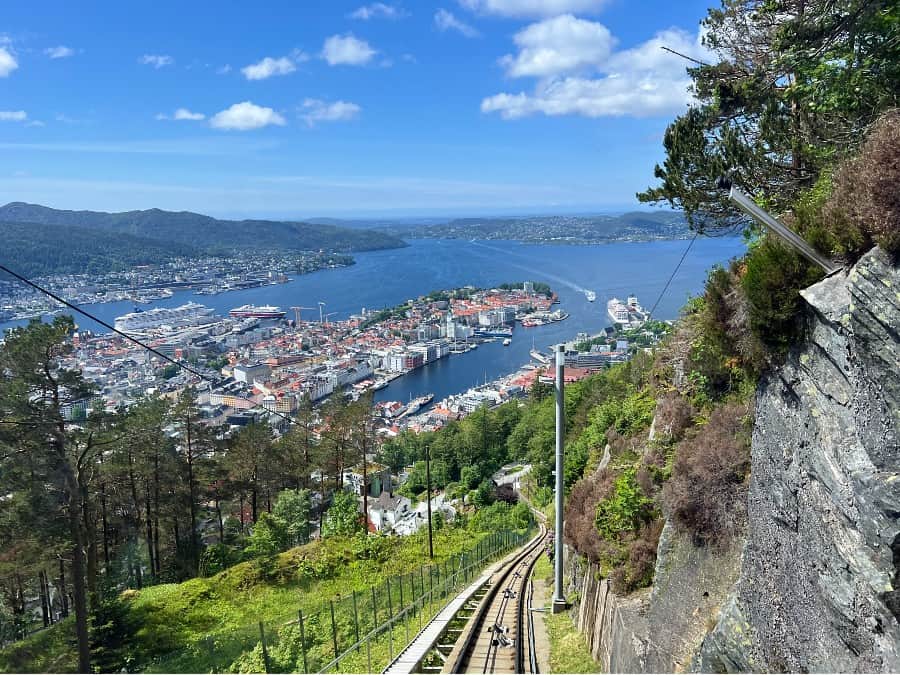
The journey is short, but it is still part of the fun.
As the funicular climbs, you start to look back over the city, with the streets dropping away and the water appearing behind the buildings.
There was one stop on the way up when we visited, then we carried on towards the top of Mount Fløyen.
At the top, most people naturally head straight for the main viewpoint.
It is easy to see why.
You get that big Bergen view over the city, harbour, fjord, mountains and colourful buildings below.
This is where we felt lucky with the weather.
Bergen is famous for rain, but we visited on a clear, bright day, and it made Mount Fløyen one of our favourite parts of the city.
If the weather is very wet or visibility is poor, we would think carefully before paying to go up.
The funicular ride would still be an experience, but the main value is the view and the time you can spend outside at the top.
We spent around 2.5 hours on Mount Fløyen, which felt right for us.
That gave us time to take photos from different viewpoints, have sandwiches in the café, see the goats, and follow part of one of the trails.
The café had a good choice of food, and we managed to get a table inside even though it was the middle of the day.
That made the visit feel more relaxed, rather than just rushing up for the view and heading straight back down.
Our biggest tip is not to stop at the first viewpoint and leave.
Walk around a little.
There are different angles over the city and water, and the top feels much more enjoyable once you move beyond the busiest photo spots.
It did feel reasonably busy near the funicular station, probably because a cruise ship was in Bergen that day.
But once we followed one of the trails into the forest, the crowds thinned out quickly.
That was one of the nicest parts of the visit.
You still know you are close to Bergen, but suddenly it feels greener, quieter and much more peaceful.
We also loved seeing the goats relaxing in the sunshine.
It added a bit of character to Mount Fløyen and made the whole place feel more than just a viewpoint.
You can walk back down to the city if you have more time and energy, but we took the funicular both ways.
For us, that was the right choice on a 1-day Bergen visit because it saved time and left enough energy for Bryggen, the Hanseatic Museum, St Mary’s Church and the Fish Market later in the day.
If you have longer in Bergen, walking part of the way up or down would be a lovely option.
But if you only have 1 day, the return funicular is the easiest and most realistic choice. Before you go, check current Fløibanen tickets, opening times and weather conditions on the official Fløibanen website.
Mount Fløyen is also one of the Bergen experiences we would highlight when seeing Oslo, Bergen and the fjords in seven days, because the funicular gives you the classic city view without taking up the whole day.
Good to know: The Fløibanen is best on a clear day, when you can actually enjoy the views from the top. If the weather is very wet or visibility is poor, check the webcam or forecast before buying tickets.
Best for: First-time visitors who want an easy mountain view without a long hike.
Allow: 1.5 hours if you only want the ride and view, or 2 to 3 hours if you want food, photos and a short trail.
Our tip: Do not stop at the first viewpoint and leave. Walk a little further, take photos from different angles and follow one of the trails if you want to escape the busiest area.
Worth it? Yes, especially on a clear day. This was one of our favourite things to do in Bergen.
3. Step Inside St Mary’s Church
St Mary’s Church is easy to miss if you are focused on Bryggen, the harbour and the colourful wooden buildings.
But if it is open when you pass, we think it is worth stepping inside.
The church sits just behind Bryggen, which makes it easy to add between the Fløibanen funicular, Bergenhus Fortress and the old wooden streets.
You do not need to make a big detour or build your whole day around it.
It works best as a short, quiet stop in the middle of a busy Bergen walking route.
St Mary’s Church is Bergen’s oldest preserved building and dates back to the 12th century.
From the outside, it has a simple, solid stone appearance, but the interior is much more detailed than we expected.
Inside, the church feels calm, historic and atmospheric.
It is not huge, but it has beautiful stonework, carved wood and a richly decorated altar area that immediately draws your eye.
The altarpiece was the part we found most striking.
It is intricate without feeling gaudy, and it gives the church much more impact than you might expect from a quick glance outside.
The pulpit is also worth looking at properly.
There is a lot of carved detail, and it helps the church feel more layered than a simple “pop in and leave” stop.
We enjoyed it because it felt peaceful and easy to appreciate, even without needing to know every detail of the church’s history.
That is important on a 1-day Bergen visit.
You want stops that add something to the day without slowing everything down too much.
When we visited, there was a large collection box near the entrance.
We were told that 100 NOK was a suggested donation rather than a fixed entry fee, so do not let that put you off going in if the setup is the same when you visit.
That said, opening times and entry arrangements can change, so it is worth checking before you plan around it.
For us, St Mary’s Church was not the biggest attraction in Bergen, but it was a worthwhile short stop.
It added a quieter, older layer to the day before we continued towards Bergenhus Fortress, Bryggen and the harbour.
Good to know: St Mary’s Church is close to Bryggen, so it is easy to add as a short stop while exploring the old harbour area. Check opening times before you go.
Best for: Historic churches, carved woodwork, quiet interiors and a short pause away from the busier streets.
Allow: Around 15 to 30 minutes, depending on how much detail you want to look at.
Our tip: Do not just look at the outside and move on. If it is open, step inside and take a few minutes to look properly at the altar, pulpit and stone interior.
Worth it? Yes, if it is open and you enjoy historic buildings. It is a good short stop, not a major half-day attraction.
4. Wander Around Bergenhus Fortress
Bergenhus Fortress is one of the easiest historic stops to add to a Bergen walking route.
It sits close to Bryggen and the harbour, so you do not need to go out of your way to visit.
That is one of the reasons we think it works well on a first visit.
You can wander from St Mary’s Church or Bryggen towards the fortress, step into the grounds, and suddenly the city feels quieter and older.
Bergenhus is one of Norway’s oldest and best-preserved fortresses, with history going back to the Middle Ages.
In the 13th century, this area was part of Bergen’s royal and political centre, when Bergen was one of Norway’s most important cities.
Today, the fortress area is a mix of medieval buildings, stone walls, green space, paths and harbour views.
The grounds are free to walk around, which makes Bergenhus a useful stop even if you do not want to pay to go inside any buildings.

We liked roaming around the fortress area because it gave us a calmer pause after the busier parts of Bergen.
It is not a huge attraction where you need hours, but it does add a different layer to the city.
If you enjoy history, old stone buildings and a bit of space away from the main harbour crowds, it is worth adding.
Bergenhus Fortress is also the kind of easy historic stop we would keep in the Norway route we’d choose for 14 days, because it adds variety without taking over the whole day.
The 2 main paid buildings to know about are Håkon’s Hall and Rosenkrantz Tower.
We went inside Rosenkrantz Tower and paid 170 NOK when we visited.
The tower is self-guided, with narrow corridors, steep stairs, historic rooms and a route that takes you gradually upwards through the building.
It is not packed with huge displays, but we actually liked that.
The exhibits felt just enough to give context without making the visit feel heavy or overwhelming.
The stairs are worth knowing about before you go.
They are narrow and steep in places, so this is not the easiest stop if you have mobility issues, struggle with enclosed staircases, or do not like climbing.
For us, the ascent was part of the experience.
It felt quiet when we visited, and by the time we reached the top, the view felt like a reward.
On a clear day, the rooftop view over Bergen is probably the best reason to pay for the tower.
You get a different angle over the city, harbour and surrounding area, and because it was quiet when we visited, we could enjoy the view without feeling rushed.
That said, we would think differently in poor weather. If it is raining heavily or visibility is low, Rosenkrantz Tower may feel less worthwhile, because the view is one of the main reasons to go inside.
In that case, we would still walk around the free fortress grounds, but we would think twice before paying for the tower.
We did not go inside Håkon’s Hall on this visit, but it is another paid historic building within the fortress area.
If you are particularly interested in Bergen’s medieval and royal history, you may want to look at combining both.
For a first-time Bergen visit, we think the free fortress grounds are easy to recommend.
Rosenkrantz Tower is worth considering if you like historic towers, do not mind steep stairs, and have clear enough weather to enjoy the view from the top.
Good to know: The fortress grounds are free to walk around, but Rosenkrantz Tower and Håkon’s Hall have separate entry fees.
Best for: History, harbour views, a quieter stop near Bryggen, and old stone buildings.
Allow: 20 to 30 minutes for the free grounds, or around 45 minutes to 1 hour if you also visit Rosenkrantz Tower.
Our tip: If the weather is poor, walk the free fortress grounds first and only pay for Rosenkrantz Tower if you still feel the view will be worth it.
Worth it? Yes for the free grounds. Rosenkrantz Tower is worth it on a clear day if you do not mind narrow stairs.
5. Explore Bryggen Properly
Bryggen is Bergen’s most famous sight, but it is easy to visit it too quickly.
Most people recognise the colourful wooden buildings along the harbour, and yes, they are absolutely worth seeing.
But Bryggen is much more interesting if you go behind the famous front.
The area has been one of Bergen’s main trading places for centuries and is now a UNESCO World Heritage Site. You can read more about Bryggen’s World Heritage status on the official UNESCO page.
Its history is closely tied to the Hanseatic merchants who lived and worked here, trading dried fish, grain and goods between Bergen and the rest of Northern Europe.
Today, Bryggen is made up of old wooden buildings, narrow passages, hidden courtyards, small shops, galleries, cafés and workshops.
From the harbour side, it can feel like a postcard.
But once you step between the buildings and wander into the back streets, it starts to feel much more atmospheric.

That was the part we enjoyed most.
We visited later in the afternoon, when the cruise ship passengers seemed to be starting to leave, so the alleyways felt much quieter than we expected.
This is also worth considering when deciding what kinds of places work best for a Norway route, because a central Bergen base makes it easier to visit Bryggen before or after the busiest part of the day.
The main harbour-facing side still felt touristy, and quite a few of the shops were clearly aimed at visitors.
But once we moved away from the front and explored the narrow wooden lanes, Bryggen felt much more interesting.
The crooked timber buildings, dark passageways and small independent businesses gave it more character than a quick photo stop ever could.
This is why we would not rush Bryggen.
Walk along the front first, take the classic photos, then go into the alleyways and courtyards behind.
Look up at the wooden details, notice how close the buildings sit together, and take your time wandering in and out of the little passages.
It is one of those places where the atmosphere matters as much as the facts.
We also stopped for coffee and cake at Kaf Kafe Bryggen, tucked inside Bryggen’s wooden streets.
That ended up being one of the nicest pauses of the day.
We sat outside, people-watched, enjoyed the setting and found the staff really friendly.
It felt like a much better way to experience Bryggen than simply walking past the colourful buildings and ticking it off.
Bryggen is popular for a reason, and it can definitely feel touristy in places.
But if you explore beyond the main frontage, it still feels special.
For a first visit to Bergen, we would absolutely include it, but we would give it proper time rather than treating it as a 10-minute photo stop.
Good to know: Bryggen is Bergen’s most famous area, so it can feel busy and touristy, especially when cruise ships are in port.
Best for: Bergen history, UNESCO-listed streets, photography, small shops, cafés and atmospheric wandering.
Allow: 45 minutes to 1.5 hours, depending on whether you stop for coffee, shopping or museums.
Our tip: Do not just photograph the colourful buildings from the harbour. Go behind the front and explore the narrow wooden alleyways and courtyards.
Worth it? Yes. Bryggen is touristy in places, but it is still one of the best things to do in Bergen if you explore it properly.
6. Walk Through The Fish Market
Bergen Fish Market is one of those places that appears on almost every list of things to do in Bergen.
It is central, easy to visit, and sits right between the harbour, Bryggen and the main city centre.
That makes it very easy to walk through as part of a first-time Bergen route.
The Fish Market has been part of Bergen’s trading life for centuries, with fishermen, farmers and locals using this area as a meeting point for food and trade.
Today, it is a mix of seafood stalls, local produce, restaurants and tourist-friendly food displays.
There is also an indoor market area, Mathallen, which is open year-round and has permanent stalls and restaurants.
The outdoor market is more seasonal, so what you see will depend on when you visit.
We walked through the Fish Market after exploring Bryggen.
By that point, it worked well as a natural stop rather than somewhere we had gone out of our way to visit.
It was interesting to see the seafood displays, different types of fish, shellfish and local produce.
The market looked clean and tidy, and we were surprised that there was no strong fish smell.
That made it much more pleasant to wander through than we expected.
It did feel touristy, and the prices looked high, although that is not especially surprising in Norway.
Fresh seafood is rarely cheap, and Bergen is a popular visitor city, so we would not expect this to be a budget food stop.
For us, the Fish Market was worth strolling through, but we would not describe it as a must-eat experience.
If you love seafood and want to sit down for fresh fish in a very central location, it may be worth budgeting for.
But if you are trying to keep costs down, we would treat it as a place to browse, take in the atmosphere and maybe compare options rather than automatically eating there.
It is also worth thinking about timing.
Because the Fish Market is so central, it can feel busy, especially around lunch, in summer or when cruise ships are in Bergen.
If you want a calmer wander, avoid the busiest middle part of the day.
For a first visit, we would still include the Fish Market because it is so easy to combine with Bryggen and the harbour.
Just go in with the right expectation.
It is a lively, convenient, historic food stop in the heart of Bergen, but it is also touristy and not somewhere we would build the whole day around.
Good to know: Bergen Fish Market has both seasonal outdoor stalls and the indoor Mathallen area, which is open year-round.
Best for: A quick wander, seafood displays, central food options and atmosphere near Bryggen and the harbour.
Allow: 15 to 30 minutes if you are just browsing, longer if you plan to eat.
Our tip: Treat the Fish Market as a wander-through stop first. Check prices before committing to a meal, especially if you are travelling on a budget.
Worth it? Yes for a short stroll. Optional as a dining stop unless fresh seafood is a priority for you.
7. Enjoy Bergen Harbour And Waterfront Views
After Bryggen and the Fish Market, we would leave time to simply wander around Bergen’s harbour and waterfront.
This is not about ticking off another attraction.
It is about slowing down and seeing the city from a slightly different angle.
Bergen’s waterfront is one of the easiest places to understand why the city grew around trade, ships and the sea.
You have Bryggen on one side, the Fish Market close by, boats in the harbour, colourful buildings along the water and mountain views rising behind the city.
We walked along the opposite side of the waterfront after visiting the Fish Market.
This gave us one of the best views back towards Bryggen, because you can see the colourful wooden buildings from across the water rather than standing right underneath them.

If you want the classic Bergen photo, this is a good place to pause.
It also helped the day feel less rushed.
By this point, we had already done KODE, Fløibanen, Mount Fløyen, St Mary’s Church, Bergenhus Fortress, Bryggen and the Fish Market, so we did not want another paid stop.
Leaving time for this slower harbour walk is part of creating a smooth route through Norway’s highlights, rather than filling every city day with one attraction after another.
A harbour walk was exactly what we needed.
We continued along Strandkaien, then wandered up past Buekorpsmuseet i Bergen and along Strangehagen.
This area felt quieter than the main harbourfront and gave us a different side of Bergen.
We liked seeing the clapboard houses, little alleyways and residential streets away from the busiest tourist spots.
It is the kind of wandering that does not always appear as a headline attraction, but often makes a city feel more memorable.
We finished with coffee and cake at Løvetann Café and Bistro before heading back towards Byparken to get the tram back to our accommodation.
That made a really nice end to the day.
For a first visit, we would not skip the main sights for this area, but we would absolutely leave space for a waterfront wander.
Bergen is one of those cities where the views, streets and harbour atmosphere are part of the experience.
You do not need to keep paying for more attractions to enjoy it.
Good to know: The opposite side of the harbour gives you lovely views back towards Bryggen and the colourful wooden buildings.
Best for: Slower wandering, harbour views, photography, coffee stops and seeing a quieter side of central Bergen.
Allow: 30 minutes to 1 hour, longer if you stop for coffee or explore the side streets.
Our tip: Do not finish your Bergen day the second you leave Bryggen or the Fish Market. Walk across or around the harbour to see the waterfront from another angle.
Worth it? Yes. This is one of the easiest free things to do in Bergen and a lovely way to end a first visit.
What To Add If You Have More Time In Bergen
If you have more than 1 day in Bergen, we would not just add more stops onto the route above.
We would use the extra time to slow the pace down or swap in one bigger experience.
Good options to consider are:
- Hanseatic Museum And Schøtstuene: Best if you want more context for Bryggen and Bergen’s trading history.
- Mount Ulriken: Best if you want a bigger mountain viewpoint or a more active day.
- Fjord Cruise From Bergen: Best if Bergen is your main fjord base and you are not doing fjord trips elsewhere in Norway.
- Bryggens Museum: Best if you want to understand more about medieval Bergen and the archaeology behind Bryggen.
- Nordnes Or Nordnes Sjøbad: Best if you want a slower waterfront wander, sauna or swim.
- More Time At KODE: Best if you enjoy art and want to visit several of the museum buildings properly.
We would treat these as swaps or second-day options, not things to squeeze into 1 already-full Bergen day.
Being realistic about these choices is part of how to avoid common mistakes when planning Norway, especially when an extra museum, viewpoint or fjord cruise could make the rest of your route feel rushed.

FAQs About Things To Do In Bergen
What Should You Not Miss In Bergen?
For a first visit, we would not miss Bryggen, the Fløibanen funicular, Mount Fløyen and a walk around the harbour.
If you have time, Bergenhus Fortress and St Mary’s Church are easy historic stops to add nearby.
Is 1 Day Enough In Bergen?
Yes, 1 full day in Bergen is enough to see the main central sights.
You will not see everything, but you can visit Bryggen, Mount Fløyen, the harbour, the Fish Market and a couple of extra stops without making the day feel impossible.
Is Fløibanen Worth It?
Yes, we think Fløibanen is worth it, especially on a clear day.
The ride is quick and easy, and Mount Fløyen gives you one of the best views over Bergen without needing to do a long hike.
Is Bergen Walkable?
Yes, central Bergen is very walkable.
We used the tram to get into the city, then explored most of the main sights on foot, including KODE, Fløibanen, St Mary’s Church, Bergenhus Fortress, Bryggen, the Fish Market and the harbour.
Leaving the car at your accommodation also helps you avoid the hidden driving costs to factor into Norway, particularly paid city parking while you are sightseeing.
What Can You Do In Bergen When It Rains?
Good rainy-day options in Bergen include KODE, the Hanseatic Museum and Schøtstuene, Bryggens Museum, cafés, shops and indoor parts of the Fish Market.
If the weather is very wet or visibility is poor, we would think carefully before paying for viewpoints such as Fløibanen or Rosenkrantz Tower.
Is Bergen Worth Visiting On A Norway Road Trip?
Yes, Bergen is worth adding to a Norway road trip if it fits your route.
It gives you a good mix of city atmosphere, mountain views, harbour history and easy walking, which can be a nice change after long driving days.
Planning How Bergen Fits Into Your Norway Trip
Once you know what is worth prioritising in Bergen, the next step is working out where it fits in your wider Norway route.
Bergen works well as a city stop between fjords, scenic drives and slower road trip days, especially if you want a mix of harbour wandering, mountain views and an easy break from long driving stretches.
You can see how the city fits into a scenic and practical Norway plan for ten days, alongside Oslo, Stavanger, fjords and some of Norway’s best driving sections.

Meet Angela
Angela is the founder and writer of GlobalGadding, a travel resource for road-trip lovers and independent travellers.
She’s explored 40+ countries, and road tripped across New Zealand, Alaska, Australia, Canada, UK, Sri Lanka, USA, Namibia, and Europe.
She creates detailed, easy-to-follow itineraries that take the stress out of planning. Her mission is to help readers craft their own self-drive trips.